
Improvement and development of scientific journals in 2026
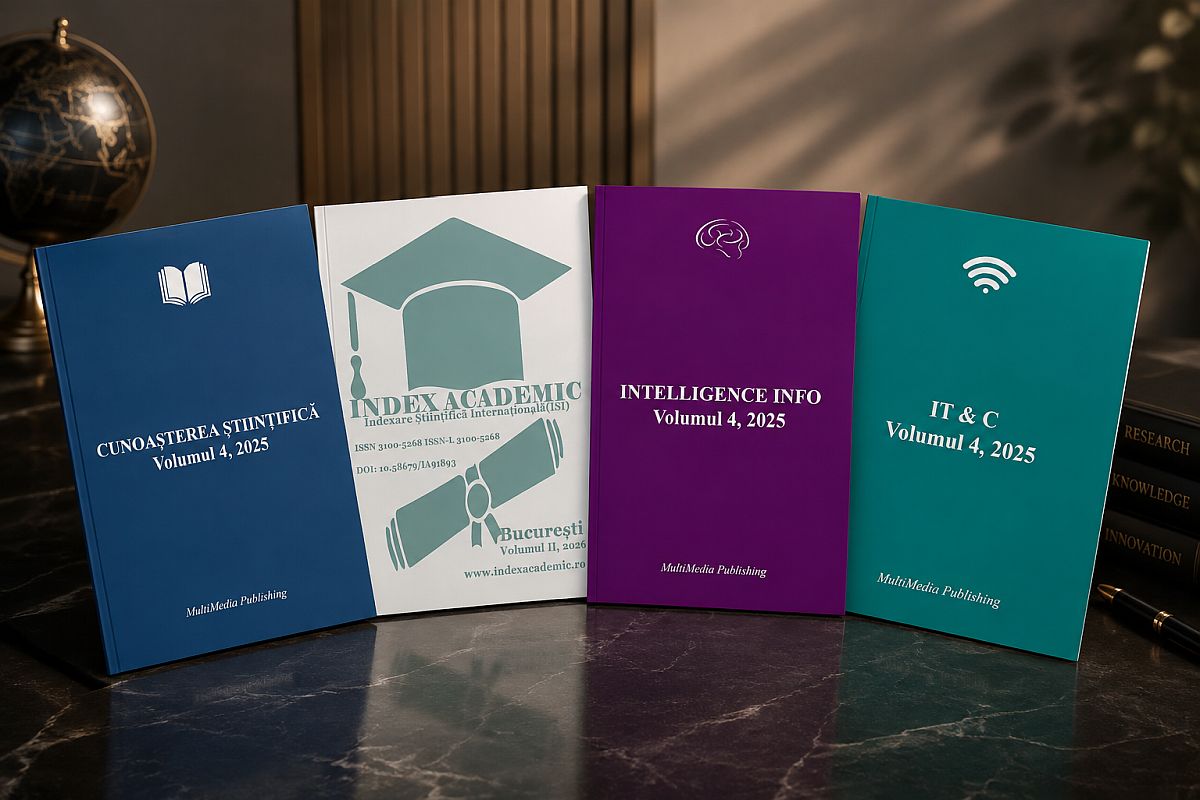
Throughout 2026, the development and professionalization process continued for the four academic publications under editorial coordination: Cunoașterea Științifică, Intelligence Info, IT & C, and Index Academic. The efforts focused on enhancing the scientific quality of the publications, improving their international visibility and accessibility, standardizing editorial processes, and preparing for the transition to a modern management system for academic publications.
An important objective was to increase the quality of the scientific evaluation process. The peer review system was strengthened, with an emphasis on double-anonymous evaluation, a clearer separation of the responsibilities of authors, evaluators and editors, and the development of more explicit instructions and criteria for evaluators. In parallel, a program was initiated to attract new volunteer reviewers, including from outside Romania, accompanied by the possibility of granting certificates attesting to scientific evaluation activity.
A major improvement was the implementation of the Open Journal Systems (OJS) platform for all four journals. The platform allows integrated management of the entire editorial flow: submission of articles by authors, their verification, designation of editors, selection and invitation of reviewers, peer review process, communication with authors and preparation of articles for publication. During 2026, the platform was installed, configured and adapted for each publication, including through an extensive localization process in Romanian.
A transition period has been established so that, from 1 January 2027, authors and editorial teams work exclusively through OJS. In the last months of 2026, the platform is already being used to process new manuscripts, in parallel with the traditional publishing system.
The editorial policies of the publications were developed and standardized: the objectives and scope of each journal, the instructions for authors, the peer review policy, the rules of editorial ethics, the policy on conflicts of interest, copyright, open access, data protection and publication conditions. The use of the Creative Commons Attribution 4.0 International (CC BY 4.0) license was adopted and explained, with the authors retaining the rights to the published works.
Special attention has been paid to the persistent identification and metadata of articles. The DOI system has been expanded and standardized, both for articles and journal issues, and metadata associated with publications has been improved to facilitate identification, citation, indexing and interoperability with international academic infrastructures.
In the same context, the integration with services and standards used in scientific communication was improved, including Crossref, ORCID and the OAI-PMH protocol. Through OJS, bibliographic information is organized in a much better structured form and can be retrieved more easily by search engines and academic services.
In 2026, the component of bibliometric indicators was also developed, by using data available from sources such as Crossref and OpenAlex. Tools were created to present some indicators related to publications and citations, while aiming to avoid an exclusively quantitative interpretation of scientific performance.
Another important step was to improve open access to scientific content. It has been decided that all digital issues of the magazines from 2022–present can be viewed and downloaded for free. This measure facilitates the access of researchers, students and the interested public to published articles and contributes to increasing the circulation and visibility of research results.
The digital archives of the magazines were also reorganized, both on the websites of the publications and in the new OJS infrastructure. Archives provide structured access to volumes, issues, articles and associated materials and create the premises for more coherent long-term digital preservation.
The four publications were included in ROAD – Directory of Open Access Scholarly Resources, an international service associated with the ISSN system, which represents an additional step for the international identification and visibility of the journals.
In the case of Index Academic magazine, the development also included the creation of a distinct academic repository component, intended for the storage and dissemination of scientific and professional works. The repository policy, submission guide, DOI policy, metadata and interoperability rules, preservation, document versions, material withdrawal and copyright were developed.
To improve the communication of research results, the possibility of using graphical abstracts was also introduced, as a complementary tool to the textual summary and as a way of synthetically and visually presenting the main ideas and results of an article.
A cross-cutting theme throughout the entire process has been the internationalization of the publications. Key information regarding the journals—such as editorial policies, instructions, and calls for submissions—is provided in multiple languages (primarily Romanian and English, with some components also available in French). This initiative aims to attract a larger number of authors and reviewers from outside Romania.
Overall, the activities carried out in 2026 focused on transforming the four journals—previously managed primarily through traditional editorial procedures—into an integrated digital publishing ecosystem. This ecosystem is built upon international academic publishing standards, transparent and rigorous peer review, persistent identifiers, interoperable metadata, open access, and a modern editorial management infrastructure.
The main results can be summarized as follows: implementation of OJS (Open Journal Systems) for all four journals; strengthening of the double-anonymous peer review system; development of a reviewer recruitment program; standardization of editorial and ethical policies; implementation of DOIs and metadata; integration of ORCID and OAI-PMH; introduction and development of bibliometric indicators; inclusion of the journals in ROAD (Directory of Open Access Scholarly Resources); provision of free access to digital issues from 2022 to the present; reorganization of digital archives; development of the "Index Academic" repository; introduction of graphical abstracts; creation of multilingual versions; and preparation for a full transition to the OJS editorial workflow, effective January 1, 2027.
